

AI connects forecasting, pricing, and assortment decisions as trade-down behavior reshapes demand.
AI in CPG forecasting helps brands respond faster when shoppers trade down and demand patterns stop behaving like history.By using AI to run scenarios, detect elasticity shifts, and separate signal from noise, CPG teams can make more defensible pricing and assortment decisions. The result is fewer surprises, tighter service levels, and better margin control.
• Trade-down behavior disrupts historical demand signals, making traditional forecasting less reliable.¹
• AI models can simulate pricing and assortment scenarios before decisions reach the shelf.²
• Forecast accuracy improves when pricing,promotion, and assortment are modeled together rather than in silos.³
• Assortment complexity increases risk when value-focused shoppers change mix faster than volume.⁴
Trade-down behavior is not simply about lower prices. It reflects a deeper shift in how shoppers evaluate value, substitute products, and respond to price changes across categories. When inflation fatigue sets in, historical baselines lose relevance, and averages mask critical mix shifts.
Traditional forecasting methods struggle in this environment because they assume stability. They rely on prior-year comparisons, static elasticity assumptions, and clean promotional calendars.Trade-down behavior breaks all three. Volume may hold while mix deteriorates,or velocity may shift from core SKUs to secondary items without warning. That creates forecast bias risk, where teams keep “correcting” to last year’s patterns and unintentionally lock in false confidence.
AI in CPG forecasting addresses this by identifying non-linear patterns in demand. Instead of asking what sold last year, AI models assess what could sell under different price, promotion, and assortment conditions. This shift from backward-looking analysis to forward-looking scenario planning is foundational in a trade-down era.

Pricing is often where trade-down pressure becomes most visible — and most risky. A price move intended to protect margin can trigger unexpected volume loss, channel shifts, or private label substitution. Without a reliable forecast, pricing decisions become reactive.
AI-driven forecasting allows pricing teams to test moves before they happen. Models can estimate how different shopper segments respond to price changes, how elasticity varies by channel, and how promotions interact with base price adjustments. This allows organizations to evaluate risk before executing changes that are difficult to reverse.
More importantly, AI helps pricing teams move beyond single-point forecasts. Scenario-based pricing analysis supports better conversations across revenue management, sales, and operations. Decisions are no longer based on instinct or urgency but on modeled outcomes that account for trade-down dynamics.
Assortment decisions carry amplified risk during trade-down cycles. Removing SKUs too aggressively can alienate shoppers,while keeping low-velocity items ties up working capital and shelf space. The challenge is knowing which items still matter when shopper behavior is shifting.
AI in CPG forecasting supports assortment rationalization by analyzing substitution patterns and cross-elasticity at a granular level. Instead of relying solely on velocity, AI evaluates how products function within the broader assortment. Some SKUs act as anchors for value perception, even if their sales decline.
Retailers also have less patience for “neutral”assortment complexity in a trade-down era. If shelf space is going to be crowded, every item has to earn its place through velocity, margin contribution, and a clear role in the value ladder. AI helps teams identify which SKUs protect the shopper’s decision path and which ones quietly create confusion, cannibalization, or out-of-stocks on the items that matter most.
This insight helps teams make more surgical assortment decisions. Rather than broad cuts, AI-guided approaches prioritize SKUs that protect category performance, retailer relationships, and shopper trust. In a trade-down era, assortment discipline becomes a competitive advantage.
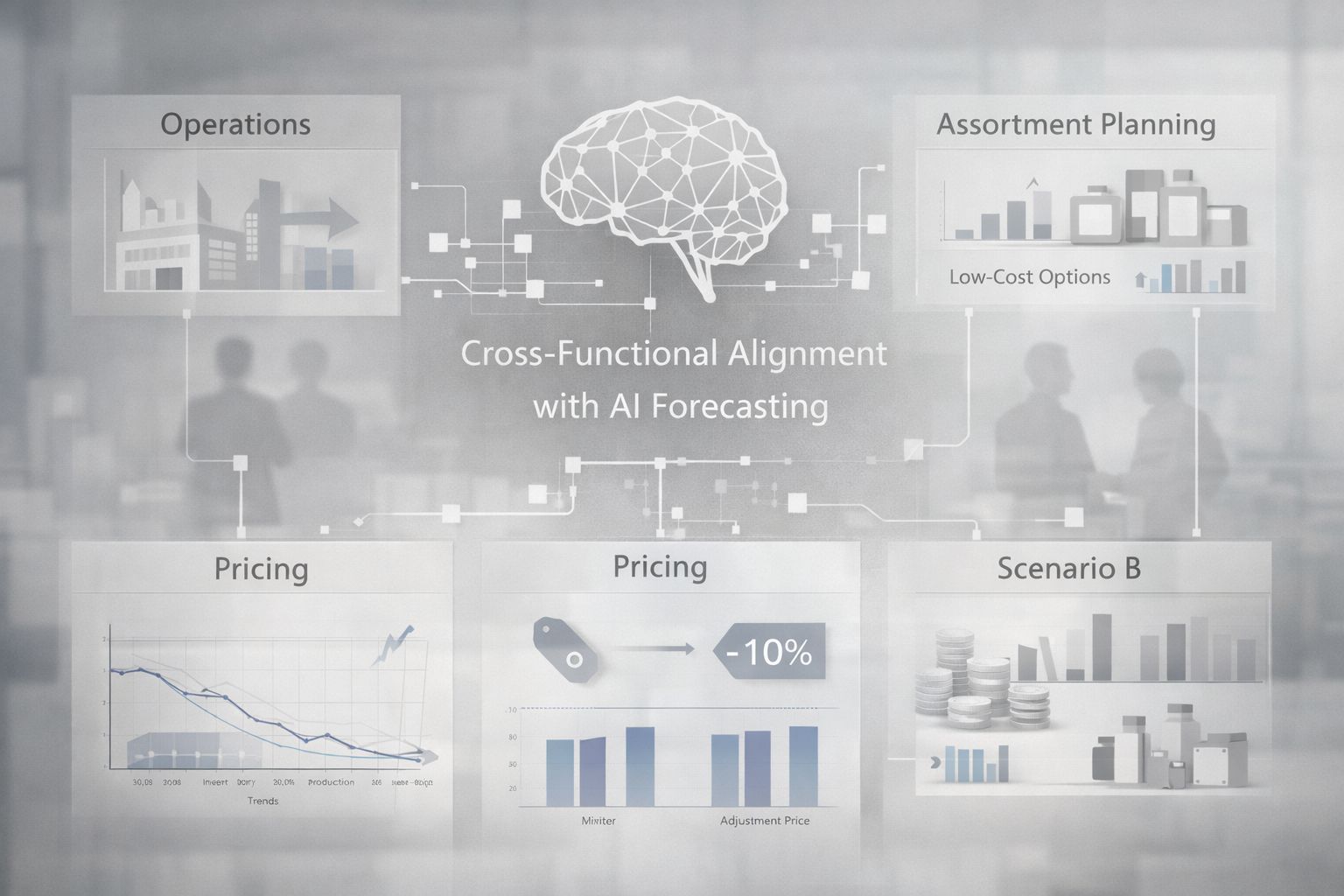
One of the most overlooked benefits of AI in CPG forecasting is organizational alignment. Trade-down behavior increases friction between teams when forecasts, pricing actions, and assortment changes are not coordinated. Operations absorb the consequences when decisions are misaligned.
AI creates a shared planning framework.Forecasts inform pricing scenarios, pricing decisions feed assortment modeling,and operations plan against a unified view of demand risk. This reduces forecast overrides, improves service levels, and limits last-minute adjustments that erode margin.
Defensible decisions are not about perfection.They are about clarity. When leaders understand the assumptions behind pricing and assortment moves, they can act with confidence — even in volatile conditions.
Trade-down behavior is unlikely to reverse quickly. The brands that adapt will be those that treat AI in CPG forecasting as an operational capability, not a technology experiment. This means integrating AI outputs into planning routines, decision reviews, and retailer conversations.
Leaders should focus on three priorities:building trust in AI-driven insights, aligning teams around scenario-based planning, and using forecasting as the connective tissue between pricing and assortment. These steps help organizations move from reactive responses to structured decision-making.
For strategy or implementation support, contact CPGBrokers below.
1. McKinsey & Company, Pricing in a Volatile Economy
2. Boston Consulting Group, How AI Improves Demand Forecasting
3. Deloitte, Advanced Analytics in Revenue Management
4. NielsenIQ, Understanding Trade-Down Behavior in Inflationary Times
