

Limited visibility across operations quietly erodes margin in growing CPG brands.
Lack of visibility in CPG operations leads to hidden margin erosion by disconnecting financial, inventory, and sales data. Without real-time alignment, brands make decisions based on incomplete information, which compounds inefficiencies as they scale.
Most brands do not realize they have a visibility problem because nothing appears obviously broken. Orders are shipping. Retailers are being serviced. Revenue is growing.
But underneath that surface, key questions often go unanswered in real time.
Teams cannot clearly see true landed cost by SKU. Inventory positions across warehouses and co-packers are not fully reconciled. Promotional spend is tracked after the fact instead of during execution. Forecasts rely more on intuition than on synchronized data.
These gaps create a situation where decisions are made with partial information. And in CPG, partial information almost always leads to margin compression.
The challenge is not just data availability. It is data alignment. When finance, operations, and sales are working from different versions of reality, even strong teams begin to drift.
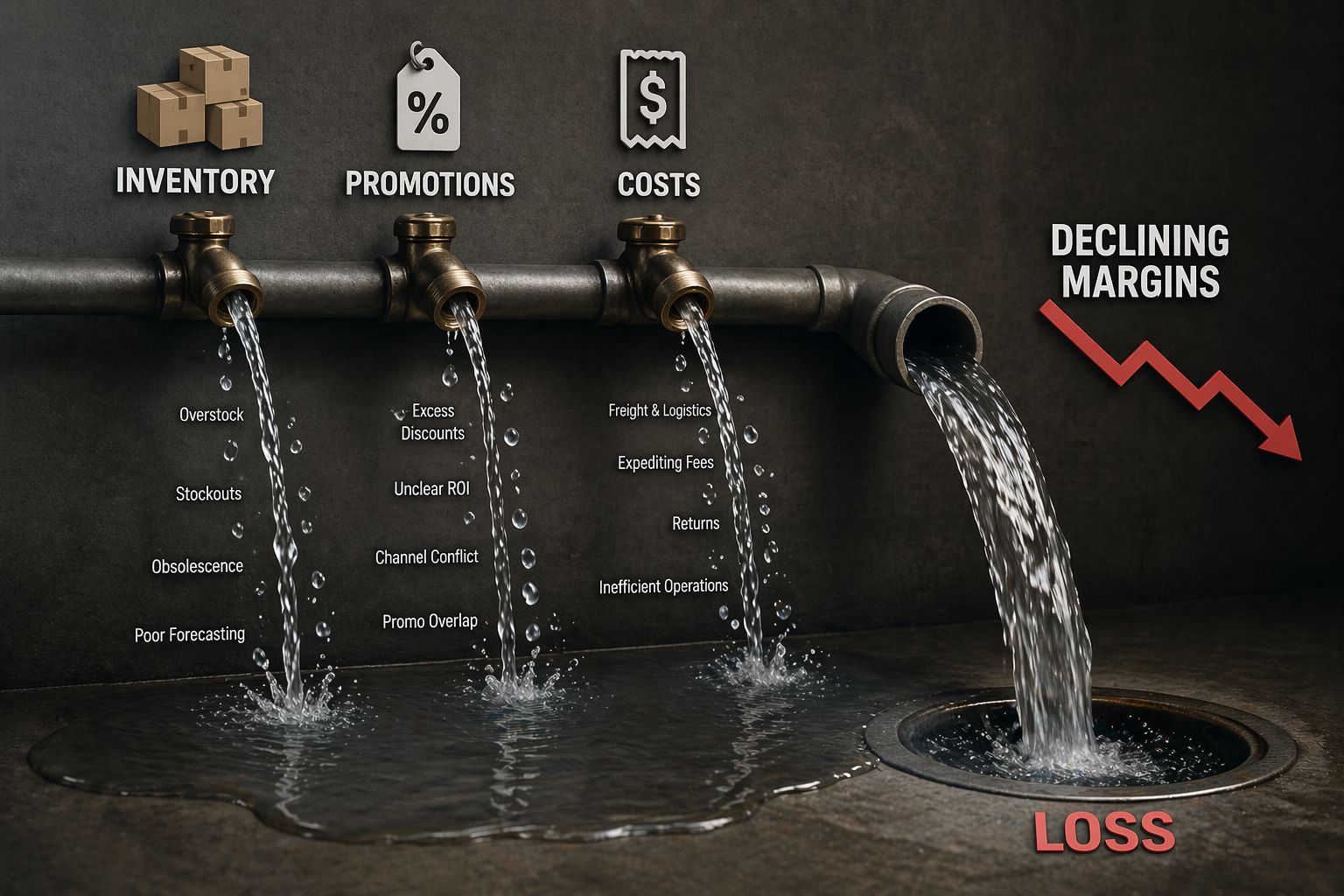
A single visibility gap might seem manageable. But the financial impact compounds quickly when multiple blind spots exist at once.
Consider how small disconnects build on each other. A brand overproduces slightly because demand signals are unclear. That inventory sits longer than expected, increasing carrying costs. At the same time, a promotion is executed without full margin visibility, eroding profitability further. Meanwhile, production costs shift due to supplier changes that are not immediately reflected in pricing decisions.
None of these issues alone would trigger alarm. Together, they quietly reduce contribution margin and strain cash flow.
This is why lack of visibility is not just an operational issue. It is a financial one. And it often goes undetected until the business feels pressure in ways that are difficult to diagnose.
Many emerging brands prioritize speed. Getting to market quickly, launching new SKUs, and expanding distribution are all valid growth strategies.
But speed without visibility introduces a different kind of risk.
When a business moves faster than its ability to measure performance, it begins to scale inefficiencies instead of resolving them. New products are launched without fully understanding cost structures. Distribution expands without clear insight into true profitability by account. Production ramps without synchronized inventory tracking.
This dynamic connects directly to a broader issue explored in The Hidden Financial Cost of Speed-to-Market. Speed can create opportunity, but without visibility, it also accelerates financial leakage.
In practice, this means that growth can mask underlying problems. Revenue increases, but margins tighten. Volume expands, but working capital becomes constrained. The business appears healthy on the surface while becoming more fragile underneath.

At earlier stages, many brands operate with lean systems by necessity. Spreadsheets, disconnected tools, and manual processes are often sufficient when complexity is low.
But as revenue approaches and exceeds the $10M to $20M range, the business crosses a threshold. SKU counts increase. Retail relationships expand. Supply chains become more layered. Financial reporting becomes more critical.
What worked before no longer scales cleanly.
The issue is not that founders are unaware of the need for better systems. It is that the transition point is difficult to identify in real time. By the time visibility gaps become obvious, they have already been affecting performance for some time.
This is why many brands in this range feel operational strain even when top-line growth is strong. The infrastructure has not caught up to the complexity of the business.
There is a common misconception that improving visibility is primarily about better reporting. More dashboards, more data, more metrics.
In reality, effective visibility is about enabling better decisions at the right time.
It means knowing true margins before committing to a promotion. It means understanding inventory positions before placing production orders. It means aligning sales forecasts with operational capacity and financial constraints.
When visibility is working properly, it reduces uncertainty. It allows leadership teams to act with confidence instead of reacting after the fact.
Without it, even experienced operators are forced into a reactive posture. Decisions are made quickly, but not always accurately. And over time, that difference shows up in financial performance.

Addressing visibility is not about adding complexity for its own sake. It is about aligning the core functions of the business so they operate from a shared understanding.
This often requires stepping back and evaluating how information flows across the organization. Where are the disconnects between sales, operations, and finance? Where are assumptions filling gaps that should be supported by data?
For many brands, the solution is not a single tool or system. It is a coordinated approach that brings together data, process, and accountability.
That shift does not need to happen all at once. But it does need to happen intentionally. Without it, the same patterns will continue to repeat, regardless of how much the business grows.
For founders and decision-makers, the early signals of a visibility problem are often subtle.
Margins that fluctuate more than expected. Inventory that feels either too tight or too heavy. Promotions that drive volume but not profitability. Cash flow that becomes harder to predict.
These are not isolated issues. They are indicators of a system that is not fully connected.
Recognizing these signals early creates an opportunity to address the underlying structure before the impact becomes more severe.
Because once visibility gaps are embedded in the business, they do not correct themselves. They expand alongside growth.
Improving visibility is ultimately about creating clarity across the business. Not just in what has happened, but in what is happening now and what is likely to happen next.
This is where operational discipline begins to intersect with financial performance in a meaningful way.
As brands continue to grow, the ability to see clearly across functions becomes a competitive advantage. It allows for more precise decision-making, more efficient use of capital, and more sustainable growth.
And it sets the stage for deeper operational improvements that go beyond visibility alone.
For brands navigating this stage, the goal is not perfection. It is alignment. Because once the business is aligned, visibility becomes a tool for growth rather than a source of friction.
If visibility is a concern, contact us below, for strategy or implementation support.
1. McKinsey & Company, “Supply chain visibility: From concept to value”
2. Deloitte,“Improving supply chain performance through visibility”
3. Harvard Business Review, “A Better Way to Manage Inventory”
4. Bain & Company, “Speed and complexity in consumer products”
