

Retail buyers evaluate financial discipline before brand ambition.
Retailers expect emerging CPG brands to demonstrate financial discipline before they demonstrate brand ambition. They want proof that your margins are realistic,your promotional plans are funded, your cash flow is stable, and your execution will not create risk inside their system.
Retail buyers assess emerging brands through a risk-adjusted financial lens, not just product differentiation.¹
Trade spend is an expected cost of retail participation, not a discretionary decision.²
Contribution margin, not theoretical gross margin,determines sustainability.³
Service failures and deductions quickly erode buyer confidence.⁵
Financial instability is a common driver of early de-listings.¹
Retailers are not evaluating your product in isolation. They are evaluating the financial impact of adding your SKU to a live system.
Every new item consumes shelf space, working capital,replenishment labor, and promotional planning time. If velocity under-performs or service levels break down, the retailer absorbs disruption long before you do.¹
From their perspective, risk appears in predictable forms:inventory that does not turn, margin that compresses under promotion,inconsistent fill rates, compliance errors, or vendors who cannot withstand payment cycles.¹ ⁴
An emerging brand that understands this speaks differently in a buyer meeting. Instead of focusing only on brand story or consumer appeal,they discuss margin structure, promotional modeling, and supply continuity.That shift in tone signals operational maturity.
Retailers are not looking for perfection. They are looking for predictability.
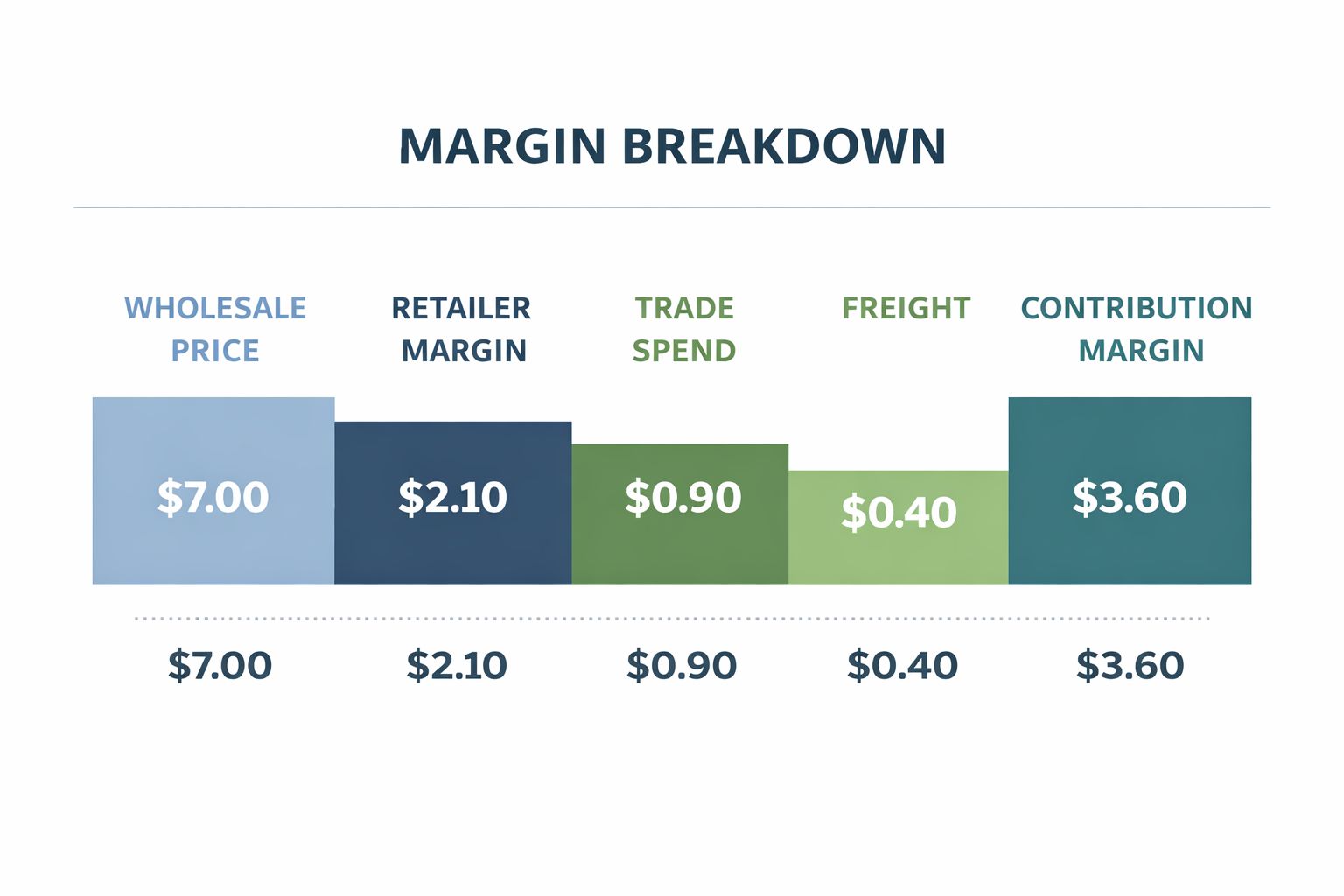
Many emerging brands enter retail with a margin calculation built for direct-to-consumer or early wholesale distribution. Retail immediately changes that math.
The retailer requires margin. Brokers require commission.Freight fluctuates. Promotions compress price. Temporary price reductions are not occasional; they are part of the system.²
A margin that appears strong at launch can narrow quickly once trade programs activate.² ³
Retail buyers assume you understand this. If you hesitate when discussing promotional depth or margin after allowances, they immediately question whether your pricing was engineered for scale.
Margin discipline means building your pricing structure to withstand:
• Promotional frequency
• Introductory funding
• Off-invoice programs
• Freight variability
• Spoilage or shrink
If those pressures eliminate profitability within the first year, the problem is not retail. It is structural planning.
Emerging founders often frame trade spend as a negotiation point. Retailers frame it as participation in category growth.
Promotions drive traffic. Traffic drives basket size. Basket size supports the retailer’s economics. Your brand is expected to contribute to that ecosystem.²
Trade is not simply a marketing tactic. It is a financial commitment.
Brands that fail to accrue properly for trade almost always overestimate profitability.² ³ They enter year one believing margins are strong, only to discover that promotional participation absorbs far more than anticipated.
Financially disciplined brands take a different approach.They build promotional calendars before authorization, model multiple promotional depths, and test margin resilience under conservative assumptions.
When you can walk a buyer through that planning, the conversation shifts from risk assessment to partnership evaluation.

Retail payment terms create a timing gap between expense and revenue. Production, freight, and commissions are paid before invoices are collected.¹
That working capital gap has ended many promising brands.¹
Buyers recognize the pattern. When inventory begins arriving late or promotional support weakens, financial strain is often the underlying cause.
You do not need unlimited capital to succeed in retail. But you do need realistic modeling of payment cycles, production lead times, safety stock requirements, and promotional lift.
Brands that acknowledge this gap and plan for it communicate stability. Brands that ignore it eventually reveal it.
Cash flow discipline is not discussed publicly in buyer meetings, but it is quietly evaluated through performance.
Gross margin is frequently cited. Contribution margin determines survival.³
Once trade, freight variability, commissions, and incremental operating costs are considered, the true economic picture becomes clearer.³
A brand may show a 40 percent gross margin on paper but operate at a contribution margin that leaves little room for reinvestment or volatility. That strain eventually limits growth.³
Retailers indirectly measure your contribution discipline through consistency. If promotional participation remains steady, service levels remain high, and expansion does not strain supply, they infer financial strength.
Brands that understand contribution economics make better decisions about SKU expansion, pack sizes, and channel growth. They expand from a position of strength rather than optimism.

Service levels are not viewed as operational metrics alone.They are interpreted as financial indicators.⁴
Missed deliveries, deductions, and compliance issues do more than create administrative noise. They suggest planning gaps or capital constraints.⁴ ⁵
Retail buyers remember patterns. A brand that consistently delivers on time and in full earns a reputation for reliability.⁴ A brand that struggles to maintain fill rates is seen as unstable, even if the product sells.
Execution discipline and financial discipline are inseparable in retail. One reflects the other.
Retailers do not expect emerging brands to operate like global enterprises. They do expect clarity.
Before entering your next retail conversation, the more important questions are financial:
• Can our margin withstand full promotional participation?
• Have we modeled payment terms conservatively?
• Do we understand our contribution margin after trade?
• Can we scale without degrading service levels?
If those answers are disciplined and documented, buyer confidence increases.
If they are uncertain, that uncertainty will surface in performance.
Retail financial expectations are consistent across categories. The brands that scale are rarely the most enthusiastic. They are the most prepared.
Financial discipline is not defensive. It is strategic positioning.
If you want a fast, reality-based review of your retail margin model and launch readiness, book a conversation with us below.
1. FMI – The Food Industry Association, Food Retailing Industry Speaks
2. McKinsey – How analytics can drive growth in consumer-packaged-goods trade promotions
3. Circana – Price & Promotion solutions
4. NRF – Supply chain topics
5. SupplyPike SupplierWiki – Understanding retailer deductions, chargebacks, and fines
