

Retail deductions often reveal operational problems long before brands recognize the full margin impact.
Retail deductions can quietly erode profitability long before emerging CPG brands recognize the operational problems causing them. As retail distribution expands, deductions tied to OTIF penalties, shortages,pricing discrepancies, and compliance failures often increase faster than internal controls, creating hidden margin pressure and unpredictable cash flow.
A founder finally gets the call they have been chasing for years.
A regional grocery chain is expanding distribution. Purchase orders are growing. Velocity looks healthy. Retail sales are climbing month after month. On paper, the business appears to be entering its next stage of growth.
Then the cash flow pressure starts.
The finance team notices invoice discrepancies. Shortage claims begin appearing more frequently. Promotional deductions are larger than expected. OTIF penalties start hitting invoices. Retailers are withholding payments while disputes remain unresolved.
Nothing feels catastrophic at first.
A few thousand dollars here. A compliance fee there. Another shortage deduction tied to a warehouse receiving issue nobody can fully explain.
But over time, the pattern becomes impossible to ignore.
The company is shipping more product than ever while profitability becomes harder to predict.
For many emerging CPG brands, this is where the real operational complexity of retail begins.
Retail deductions are one of the most underestimated margin threats facing growing brands under $20 million in revenue. Not because founders are careless, but because deductions often emerge gradually inside fast-moving organizations that are heavily focused on sales growth, retailer expansion, and operational survival.
Most emerging brands initially view deductions as part of the normal cost of doing business with large retailers. In reality, deductions are often operational signals pointing to deeper breakdowns inside the business.
A retailer deduction rarely happens in isolation.
It is usually connected to shipping inconsistencies,incomplete retailer compliance processes, pricing mismatches, freight coordination failures, distributor communication gaps, invoice timing issues, or weak internal ownership.
The problem is that deductions accumulate quietly.
Unlike a major supply chain disruption or a failed product launch, deduction erosion happens incrementally. The impact spreads across accounting, operations, logistics, sales, and retailer relationships at the same time. Because the losses are fragmented, leadership teams often underestimate the total margin impact until profitability begins tightening across the organization.
That timing matters.
Emerging brands are typically operating with compressed margins already. Freight costs remain volatile. Promotional spending continues increasing. Retailers expect stronger compliance performance while simultaneously reducing operational flexibility for suppliers.
At the exact moment brands are investing heavily in growth, deductions begin pulling cash back out of the business.
This creates one of the more dangerous illusions in emerging CPG growth:
Revenue can rise while operational profitability quietly deteriorates.
For brands scaling quickly, deductions also expose a common infrastructure gap. Many organizations build sales capabilities faster than operational control systems. Teams prioritize account expansion, retailer presentations, and new distribution opportunities long before they establish mature deduction management processes.
The result is predictable.
As order volume increases, operational friction multiplies faster than visibility.

One retailer may deduct for OTIF failures. Another disputes promotional pricing. A distributor submits delayed reporting. Freight documentation becomes inconsistent across facilities. Internal teams operate from different datasets while finance attempts to reconcile deductions weeks or months after they occur.
Eventually, nobody has a complete picture of where margin leakage is actually happening.
This is where deductions become more than an accounting issue.
They become a strategic operating issue.
The brands that navigate retail scale successfully are rarely the brands with zero deductions. Retail complexity makes that unrealistic. The stronger operators are the brands that develop systems to identify, classify, dispute, and reduce preventable deductions before they become systemic.
Some deductions are operationally unavoidable. Others stem from controllable process failures. Others may be inaccurate altogether and remain undisputed simply because the organization lacks the bandwidth or systems to challenge them effectively.
OTIF penalties, shortage claims, pricing discrepancies, promotional deductions, routing violations, and damaged product claims often appear disconnected on the surface. In practice, they frequently point back to a smaller number of recurring operational weaknesses.
That distinction matters because many brands unknowingly normalize deductions instead of diagnosing them.
Once that happens, margin erosion becomes embedded inside the business model itself.
Many emerging brands absorb deductions quietly because individual claims rarely appear severe in isolation.
The larger danger comes from accumulation.
A 1% to 3% unmanaged deduction rate may not initially appear threatening, particularly during periods of aggressive retail growth. But for emerging brands already operating with compressed margins, those percentages can materially alter profitability and cash flow predictability over time.
The financial impact compounds faster than many founders expect.
As distribution expands, deduction volume scales alongside it. More retailers create more compliance requirements. Larger order volumes increase the likelihood of receiving discrepancies. Additional distributors and logistics partners introduce more communication layers and reporting delays.
At the same time, finance teams become increasingly reactive.
Instead of analyzing deduction trends strategically, teams spend growing amounts of time reconciling claims manually, researching shortages, validating freight documentation, and responding to retailer disputes weeks after deductions have already affected cash flow.
The operational burden spreads across the organization.
Sales teams try to preserve retailer relationships while escalating disputes internally. Operations teams investigate warehouse inconsistencies. Finance teams struggle to maintain deduction visibility across disconnected systems.
Without centralized ownership, deduction management becomes fragmented very quickly.
That fragmentation creates another hidden risk.
Retailers become accustomed to limited push back while brands continue forecasting growth using revenue assumptions that may not fully reflect actual margin recovery challenges underneath the business.
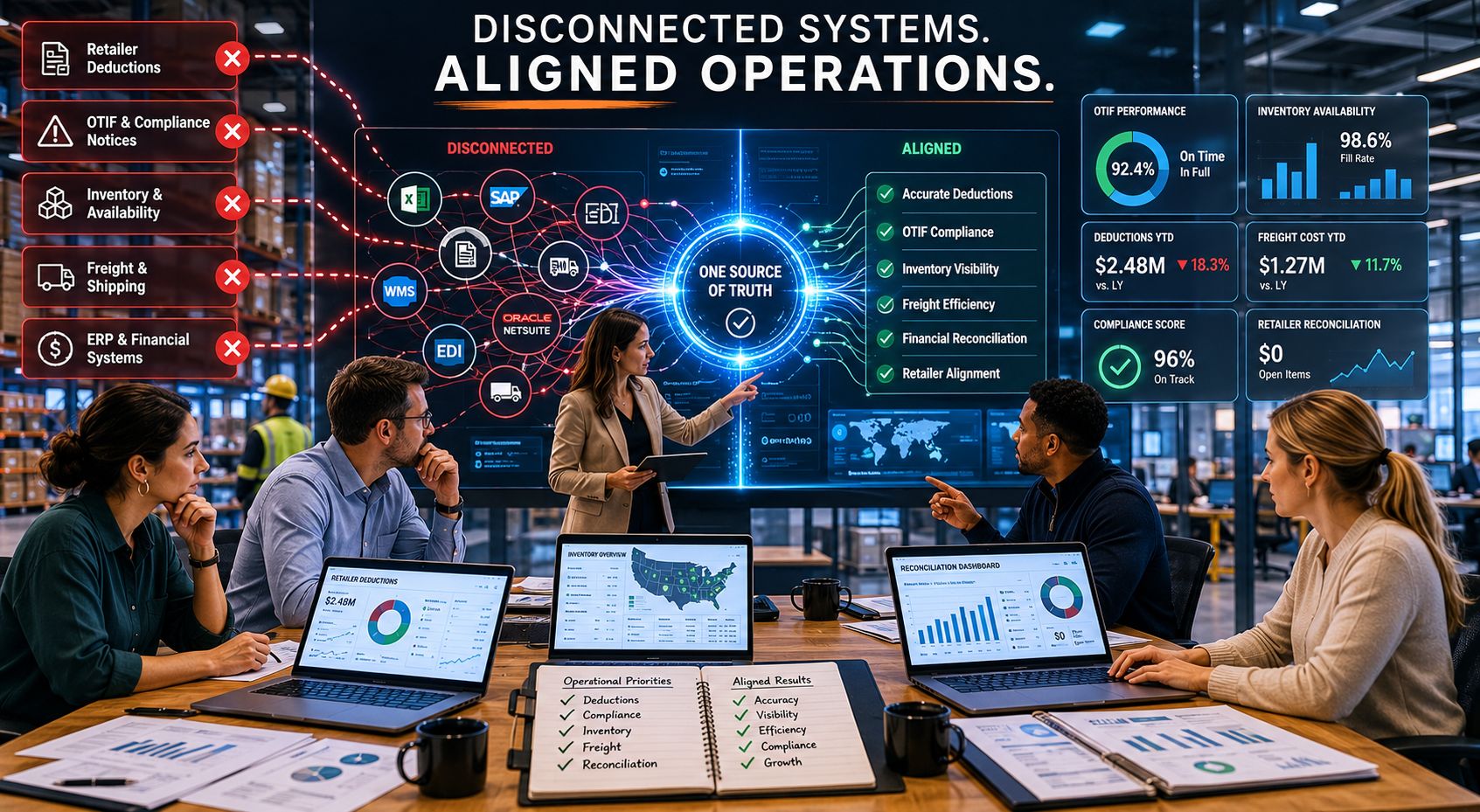
Most deduction issues originate upstream long before the retailer formally issues a chargeback.
In many cases, the deduction itself is simply the final visible symptom of an earlier operational breakdown.
The root cause may trace back to inaccurate retailer setup data, weak ASN coordination, invoice timing mismatches, disconnected ERP systems, inconsistent freight documentation, or unclear accountability between internal departments and external partners.
These problems often intensify between roughly $5 million and $20 million in annual revenue because complexity begins scaling faster than operational discipline.
A company that once managed retailer relationships through informal communication suddenly faces stricter routing requirements, tighter compliance windows, and larger inventory movements across multiple channels.
Processes that once worked adequately at smaller scale begin failing under larger operational demands.
This is also the stage where many organizations discover they lack centralized deduction visibility altogether.
Different teams may own separate pieces of the process, but nobody owns the complete deduction lifecycle from identification through resolution and prevention.
As a result, recurring deduction patterns remain hidden longer than they should.
The brands that stabilize margins during growth phases typically stop treating deductions as isolated retailer events and start treating them as operational intelligence.
That shift changes decision-making.
Instead of simply absorbing deductions as overhead, leadership teams begin identifying repeat patterns, validating root causes, strengthening retailer compliance processes, and improving dispute recovery systems before problems compound further.
The goal is not eliminating every deduction.
Retail complexity makes that unrealistic.
The goal is building operational maturity early enough to prevent avoidable margin leakage from becoming systemic.
That usually starts with stronger visibility.
Brands that improve deduction performance tend to centralize reporting, separate valid from invalid deductions, identify recurring retailer trends, assign internal accountability more clearly, and create faster escalation processes for dispute resolution.
Over time, these organizations gain something many emerging brands lack during rapid growth phases:
Predictability.
Retailers are becoming increasingly sophisticated in how they enforce compliance standards, recover operational costs, and manage supplier accountability. Emerging brands that continue relying on fragmented spreadsheets, delayed reporting, or reactive deduction handling often discover that profitability deteriorates even while retail distribution expands.
The companies that scale more profitably are usually the ones that recognize deductions as operational warning signs early, strengthen infrastructure before complexity accelerates, and build systems capable of supporting sustainable retail execution.
Retail deductions are rarely isolated accounting problems.
More often, they reveal where operational infrastructure is struggling to keep pace with growth.
For emerging CPG brands, that distinction matters because unmanaged deductions can quietly undermine profitability long before leadership teams fully recognize the scale of the problem.
The brands that navigate retail growth most effectively are usually not the brands avoiding all deductions. They are the brands building stronger operational controls, clearer accountability, and better retailer execution before margin erosion becomes normalized.
For assistance in recognizing strategic areas of concern, contact us below.
1. Inbound Logistics — “Chargebacks and Compliance Penalties Continue Pressuring Suppliers”
2. FMI— “Supply Chain Visibility and Retail Operations Best Practices”
3. Grocery Dive — “OTIF Compliance Standards Continue Tightening for Suppliers”
4. McKinsey & Company — “Supply Chain Resilience and Operational Visibility”
